Showing posts with label fine art printing. Show all posts

Friday, February 9, 2018

5 Tips for Caring for Your Canvas

There's no better feeling than unboxing a beautiful piece of art and hanging it just so on the wall. But now that you have this fantastic piece of valuable canvas art, how to maintain it? We have 5 tips below for caring for your canvas print.


1. Keep It Out of the Sun


All of our canvases are sprayed with a special UV resistant coating that sets the ink within the canvas. However, it is still best to keep it out of direct sunlight and fluorescent lighting, as continued exposure can degrade through the coating over time.

2. Clean with a soft, microfibre cloth, or feather duster. 


No force is necessary; just gently wipe to dust, or dampen the cloth with a little water if need be. Make sure not to press as you skim over the center, as this is where the canvas is most vulnerable. Do not use any chemicals when cleaning, as this can react with the UV coating and damage it. Dusting daily is also recommended, as it helps prevent dust buildup that may eventually be harder to clean.

3. Keep It Out of Hot and Wet Environments


Humidity, heat and air pollutants can damage the canvas and inks. To avoid this, keep your canvas out of kitchens, bathrooms, or heat sources such as air vents, air conditioners, and radiators. For bathroom and kitchen decorating, we recommend framed fine art prints, which are protected by plexiglass. In general, keep such artwork out of heat, sunlight and moisture as much as possible.

4. Hold Onto the Sides When Moving


Sometimes canvases have to be moved, and in which case we always recommend holding the print by the wooden stretcher frames inside. Do not lean anything against either the front or the back of the canvas, as it can stretch the fabric, create a dent, or worse, tear it.


5. Spray Behind the Dents


In the event that dents are unavoidable, there is a simple solution to minimizing it. Simply spray the back of the canvas with a bit of water where the dent is, and leave it overnight to 24 hours. By then, the moisture should help reset the fibers and sooth out the dent.

---

VancouverOnCanvas is a local printing, framing, fine arts and reproduction company. We also supply artist materials such as custom canvases, primed and unprimed, as well as stretcher barswood panels, etc. Check out our supply section today!

KeenArt Media Ltd. 604-421-8000 (KeenART)
8:30 AM to 5:00 PM Monday to Thursday
8:30 AM to 4:00 PM Friday 

Wednesday, July 26, 2017

Photographing Artwork Vs Flatbed Scanning for Print Reproduction


When it comes to making prints, there are two popular ways of capturing the original painting. One method is by camera photography, and the other is by scanning. Today we will be discussing how each method is implemented, as well as outlining its strengths and weaknesses.


Photographing Your Artwork


This method is by far the most common and most cost effective. Depending on the amount of resources you have available, photographing your artwork can be done with your cellphone camera, or with a high-end DSLR. Of course, each method will result in different levels of quality.

The first thing you need to know is photographing your artwork requires a specific environment. In order to capture the best color accuracy, your painting needs to be set up in just the right kind of lighting for the camera. You will need the following:


  • Easel - for holding your artwork upright and square to the camera
  • Camera - whether it is with your iPhone or DSLR. Make sure it has a resolution of at least 14 megapixels.
  • Tripod - to make your camera level, square, and aligned with your artwork, and to eliminate shake or vibration
  • Good lighting - in overcast outdoors, or a room filled with natural light, or with a light kit that consists of light stands, strobe heads, soft boxes or umbrellas (that cost roughly $600 - $1000 on Amazon)


Photographing With Your Phone Camera


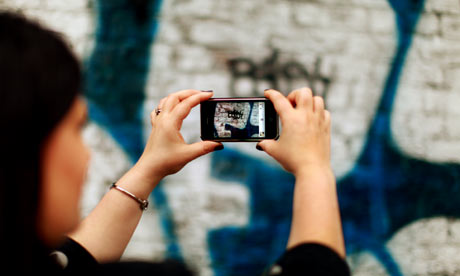
Woman Snapping Photo of Art with Smartphone

It's no surprise that snapping your artwork with an iPhone would be a popular choice. They are portable, intuitive and convenient, and great for snapping quick shots to upload to your social media channels.  Especially with the quality of camera built in these days, along with their color-editing apps, phone cameras are able to capture a surprising amount of visual detail and color.

However, iPhones do come with their own limitations. The first is the low level of control and consistency. Phone cameras do not have a manual setting in which your viewfinder can be adjusted. Rather, it will automatically focus on what it thinks is best, which may not capture your artwork accurately. Phone cameras are harder to align parallel to your artwork, which may also result in warping proportions and scale.

For these reasons, we would only recommend photographing with your phone camera for personal projects in which identification and sentiment are more important than color or scale accuracy- for example, snapping old photos from a picture album for a collage, printing images for a diy birthday card, or a canvas print of your favourite trip for your home decor.


 Photographing With a Digital SLR Camera


Armed with more manual and powerful settings, a DSLR camera is another popular way of capturing artwork for print reproduction. To do this, artists or photographers usually have a room dedicated for capturing original paintings.


An example set up for photographing artwork, sourced from
https://www.dpreview.com/forums/thread/2833131


https://rgdigitalphotographytips.files.wordpress.com/2011/06/setup.jpg


Digital SLR cameras allow you to capture and output images at higher resolution and clarity. They are also excellent for taking photos of artworks that are potentially still wet, like oil paintings or oil pastels.

Example of Photograph vs Scan by Sam Flegal. Example sourced from artistjourney.wordpress.com

However, they are also at risk to issues such as lens distortion and uneven lighting. Uneven lighting can cast shadows, influence colors and pick up highlights, all of which would be difficult to edit out. Lens distortions occur when the angle of the camera results in parts of the image becoming farther away and other parts becoming closer. This means certain parts of the image will appear larger than others.

As aforementioned, uneven lighting can be solved with an environment full of natural, uniform light. To keep glares and highlights at a minimum, photograph the piece before glazing the artwork. While an easel and tripod can help with lens distortion, the best way to minimize it is to take a picture of the artwork from above. This ensures that the camera is positioned in the very centre of the image, and the space around the image allows for any corner distortion. Using the zoom function will help as well.


Scanning Your Artwork


Because all of the previous methods are at mercy to so many outside factors, eliminating as many of them would be the best course of action. This is where scanning comes in.

Our Epson 11000XL Scanner, flatbed, with optical

resolution of 2400 dpi


Scanning allows for high resolution, without any lens distortion. Scanners also come in many shapes and sizes, allowing for a large artwork size. When a painting is scanned, all the raw colors are captured as is without any other influencing factors, such as shadow or lighting. This allows yourself or the production tech more control to tweak and edit the colors accordingly. The result is a digital file that is 80%-90% close to the original.

The result of a good color match.
Left: Original; Right: Print

Scanners can be flatbed, rolling or overhead. When placing your order, make sure you know which one you need. Flatbed scanners mean your artwork is placed against the glass, which may not work for paintings that are on slightly warped surfaces, or are wet, such as oil paintings. Rolling scanners can scan large flat artworks, but the pressure of the rollers can damage the paint. Overheads like the Cruse scanners are best.

When it comes to making prints, the reproduction should look as similar to the original as possible. Our scanning services output a high resolution file that has been color-corrected and test-printed for the highest accuracy. Check out our scanning price calculator here. We offer scanning in both 300 dpi and 600 dpi.

Once a high-resolution file has been created, you can use the same file to print your reproduction, such as on canvas, fine art paper, or metal. You can also tweak the file and save a copy of it for your social media or website.

If you are interested in art scanning please visit our website for more information. If you already have your artwork digitized and need to make high quality fine art reproductions visit VancouverOnCanvas.com for fine art prints or canvas prints

Friday, March 3, 2017

Artist Spotlight: Peter Jurik


We're always wowed whenever we get to see artworks made by our clients, and pieces by Peter Jurik has always left us with deeply impressed.

Amy Winehouse, Peter Jurik

Born in Czechoslovakia, Peter moved over to Canada in 1968, and now resides in Vancouver. His sense of gripping realism and eye for detail is astounding, especially when it carries over a wide variety of subjects: automobiles, sailboats, wildlife, and portraiture.

The Stones, Peter Jurik

Our personal favorites are part of his Canadian wildlife collection, painted with watercolors. As watercolors are notoriously difficult to work with, it never ceases to amaze me how Jurik captures the depth of his subjects with such richness.

Couple, by Peter Jurik

You can buy some of Peter's work from his website here. We can't wait to see more from this incredible artist on his Canadiana subjects!

Victory, Peter Jurik


Would you like to be featured on our blog, or know an artist you'd like us to share? We'd love to get to know you and your thoughts! Leave your suggestions in the comments below!


KeenArt Media Ltd. 604-421-8000 (KeenART)
www.VancouverOnCanvas.com
8:30 AM to 5:00 PM Monday to Thursday
8:30 AM to 4:00 PM Friday

Fine Art Printing  At VancouverOnCanvas we offer fine art printing in a wide selection of paper styles. We also scan originals so that you can enjoy the beauty of their colors on each individual paper texture for years to come. Printed with archival inks, their brilliance is built to remain.

Friday, February 17, 2017

Artist Spotlight: CocoBee

Art as true therapy...

Here at VancouverOnCanvas, most of the staff are artistic enthusiasts. Some of us have animated, others painted, some sketched, etc. As such, we are always looking for inspiration that really resounds with us, and when we came across CocoBee's work, we knew we had to share.

Abstract Dance Watercolors by CocoBee.


Whether you do art as a hobby or as a profession, there is no doubt the experience is resonating, and extremely reflective, deep. It's no surprise that art often implemented as a means of therapy, and CocoBee's pieces, through her videos and music, truly captures the process of both artistic and self exploration.

A unique Youtube star, she combines her colorful abstract painting videos with soothing instrumentals, and a poetic narration of her thoughts and feelings as she delves through the work. The result is a deeply personal and wholly vibrant connection - from her, to the piece, to us.

Here, a snippet of her work(ing)...


Fine Art PrintingInspired? At VancouverOnCanvas we offer fine art printing and framing in a wide selection of paper styles and frames. We also scan originals so that you can enjoy the beauty of their colors on each individual paper texture for years to come. Printed with archival inks, their brilliance is built to remain. To evoke that beautiful subtle watercolor texture, we recommend the Hahnemuhle German Etching. Simply sensuous!

Would you like to be featured on our blog, or know an artist you'd like us to share? We'd love to get to know you and your thoughts! Leave your suggestions in the comments below!

KeenArt Media Ltd. 604-421-8000 (KeenART)
www.VancouverOnCanvas.com
8:30 AM to 5:00 PM Monday to Thursday
8:30 AM to 4:00 PM Friday